Timeliness matters
Forecasts must reflect the data available at issuance time
Notification, consolidation and revision have different delays. Point-in-time provenance is essential for a fair prospective evaluation.
Brazil · Epidemiological intelligence · Dengue
Dengo AI turns epidemiological, climate and territorial data into municipal probabilistic forecasts for the next four weeks. Current results are retrospective; independent validation is the next gate before operational use.
V2.0.1 · retrospective evidence · not yet operational
Dengue surveillance requires continuous monitoring, coordination across public-health levels and decisions under uncertainty.
Forecasts must reflect the data available at issuance time
Notification, consolidation and revision have different delays. Point-in-time provenance is essential for a fair prospective evaluation.
Five macro-regions with different epidemiological patterns
Performance must be monitored by municipality, region, horizon, event frequency and outbreak conditions—not only by one national average.
Models support review; they do not replace accountable professionals
Useful intelligence combines central forecasts, uncertainty ranges, traceability and human oversight.
Official context: Brazilian Ministry of Health Arbovirus Dashboard.
The V2.0/V2.0.1 reference combines epidemiological and macro-environmental signals in one national Temporal Fusion Transformer.
Weekly municipal records, climate signals, seasonality and vector-receptivity indicators with versioned provenance.
One model trained across 5,570 municipal series. This does not yet mean explicit spatial propagation modeling.
Central estimates and uncertainty intervals for T+1 through T+4 weeks.
Forecast, data and model versions designed for monitoring, review and rollback before any external alerting.
These are internal 2025 results. The year participated in model selection, evaluation and calibration; no untouched final test or prospective guarantee exists yet.
Global one-week retrospective coefficient of determination.
Global four-week retrospective coefficient of determination.
Empirical coverage observed in an internal random 50/50 recalibration split.
| Region | 1 week | 2 weeks | 3 weeks | 4 weeks | Series |
|---|---|---|---|---|---|
| Brazil | 0.9455 | 0.9157 | 0.8725 | 0.8281 | 5,570 |
| North | 0.9440 | 0.9193 | 0.8883 | 0.8551 | 450 |
| Northeast | 0.9242 | 0.8920 | 0.8609 | 0.8371 | 1,794 |
| Central-West | 0.9425 | 0.9178 | 0.8928 | 0.8729 | 467 |
| Southeast | 0.9469 | 0.9167 | 0.8729 | 0.8279 | 1,668 |
| South | 0.8926 | 0.8671 | 0.8273 | 0.7798 | 1,191 |
Retrospective internal evaluation · epidemiological source: InfoDengue · values will be re-estimated under the V2.1 point-in-time protocol.
For now, the English page reuses the same chart artwork published on the Portuguese page so both versions expose the same evidence. The surrounding captions and accessibility text are in English; translated chart artwork can replace these files later without changing the underlying data.
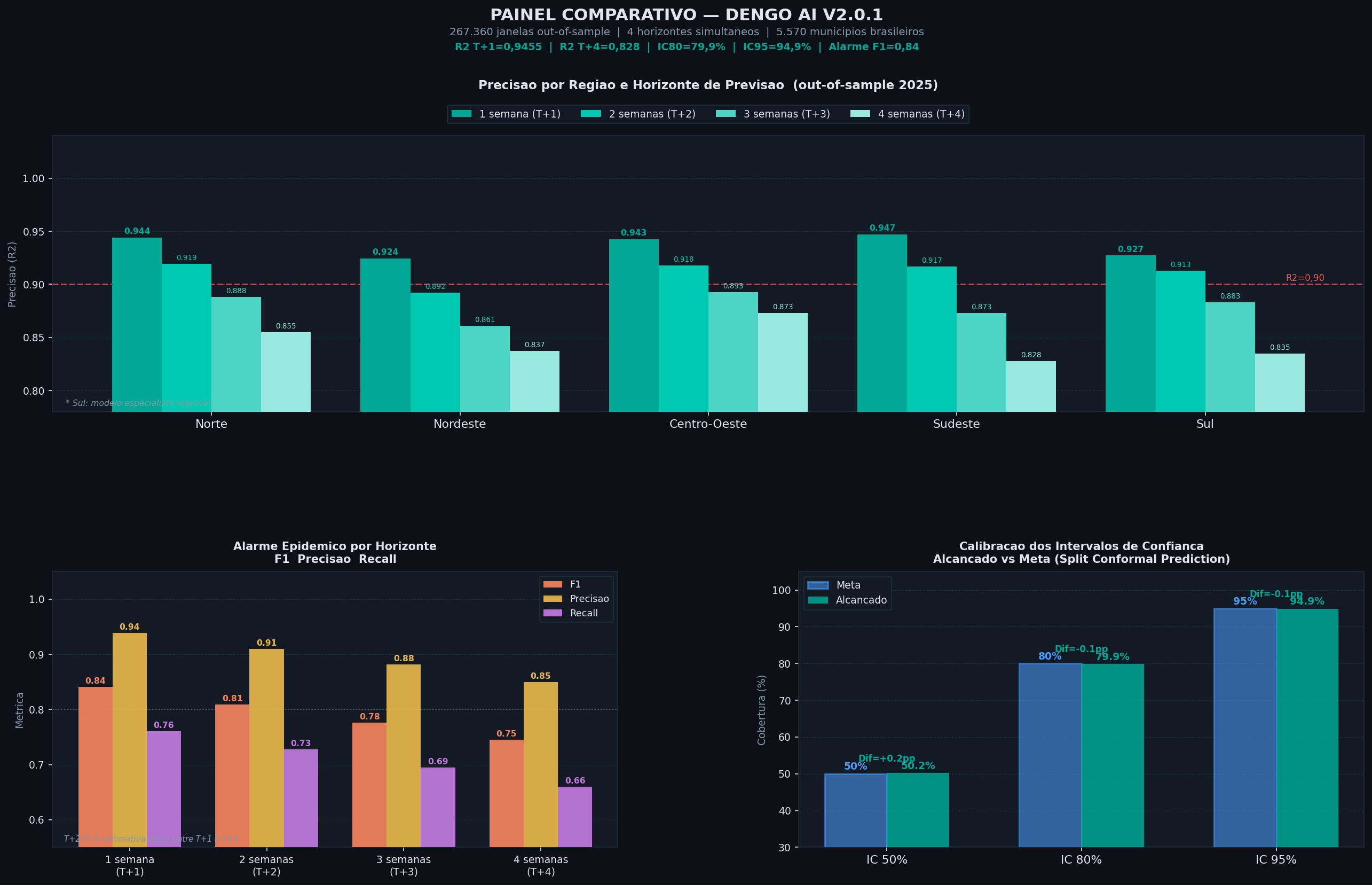
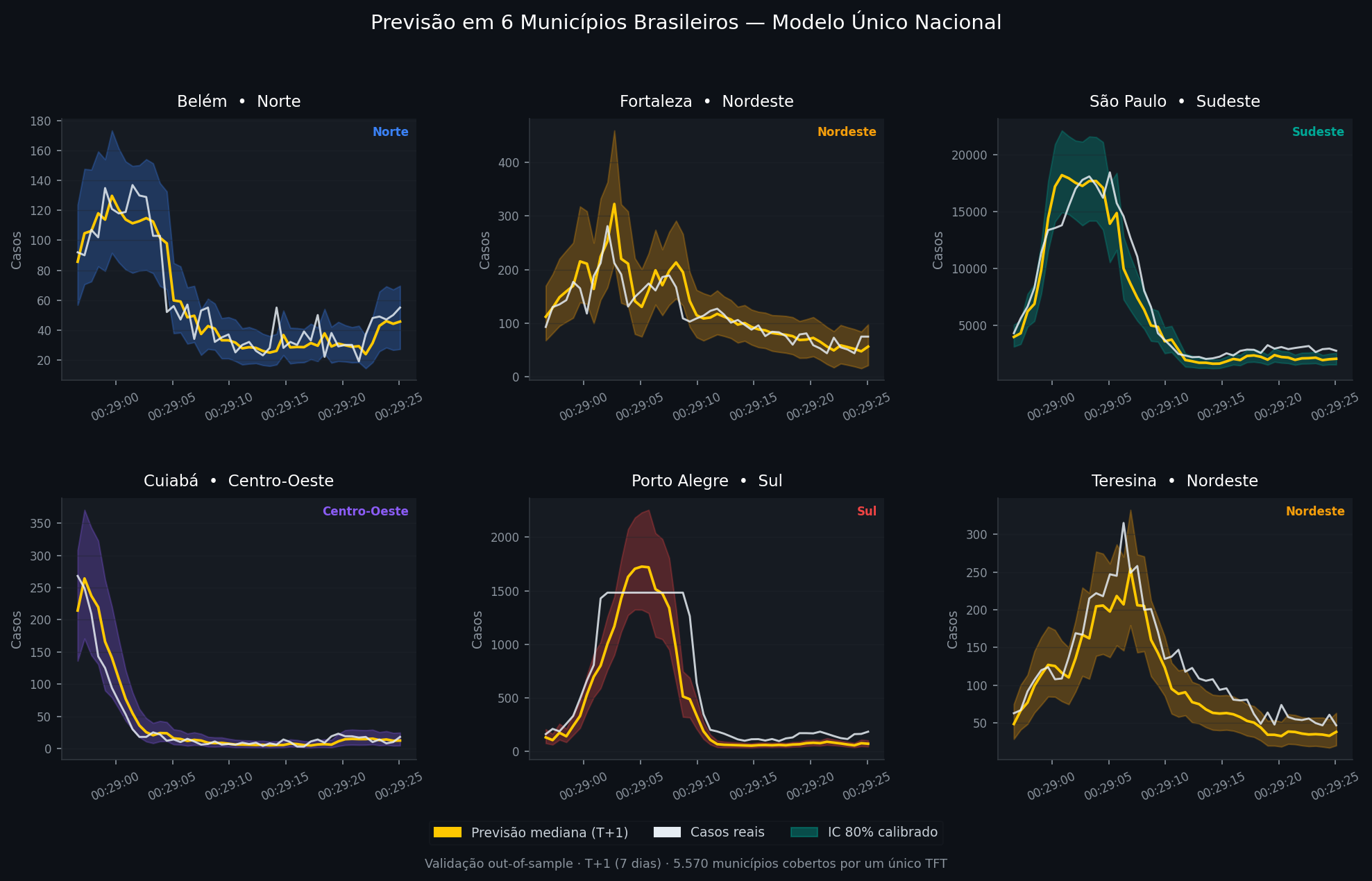
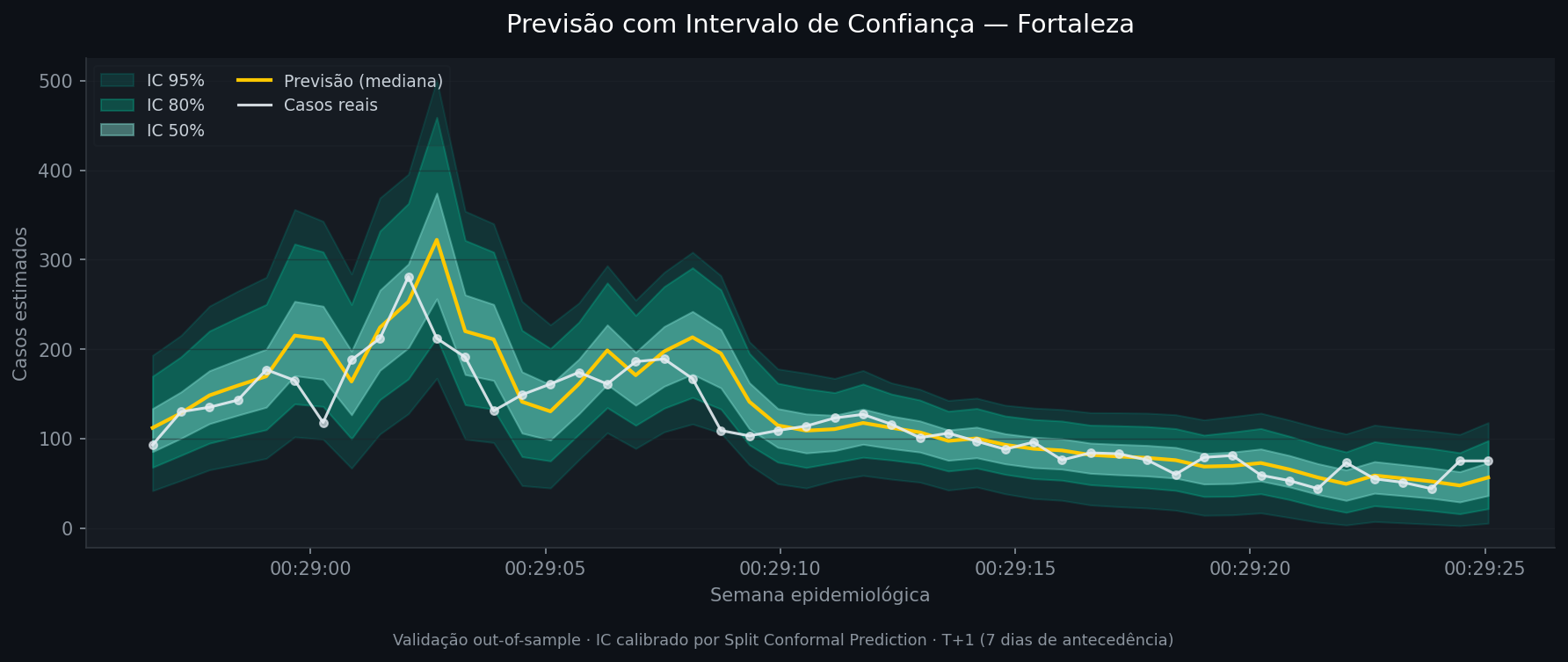
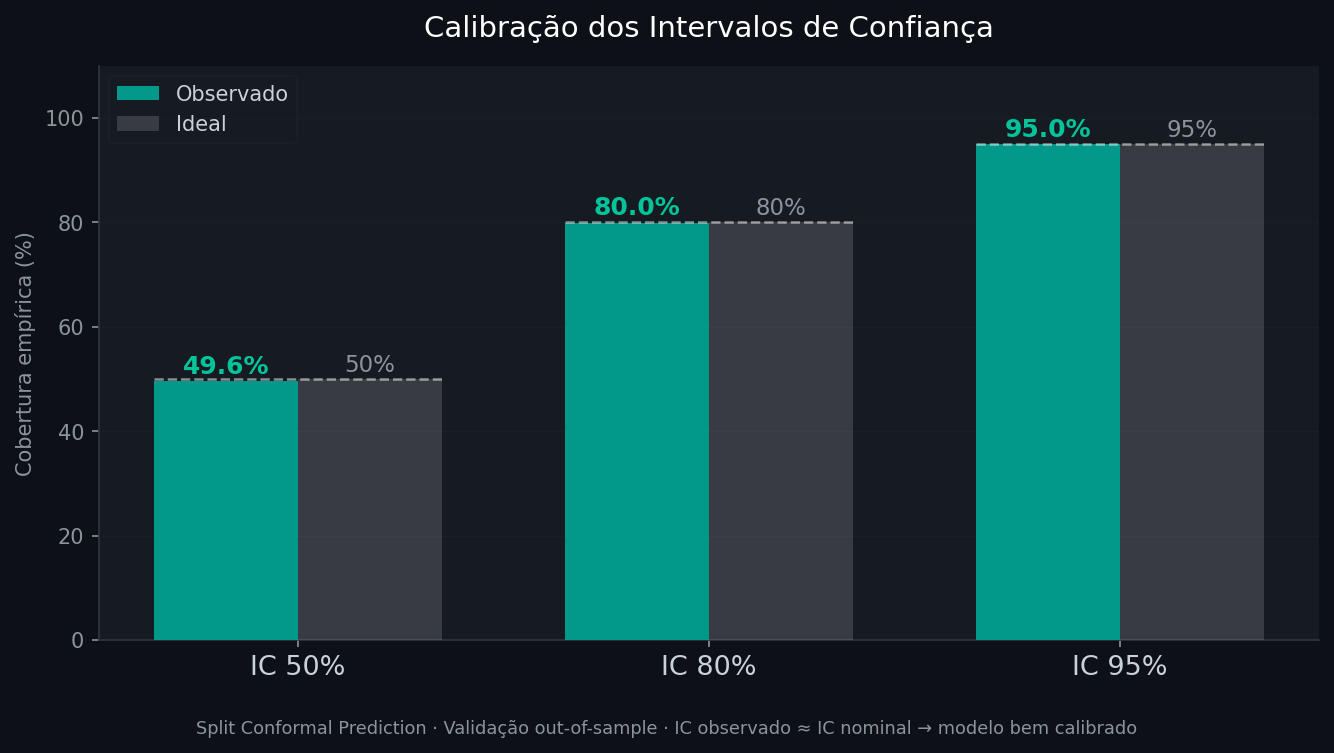
Temporary note: labels inside the chart images are still in Portuguese. English-rendered versions can replace the same image paths in a later update.
Public-health management is the primary market. Private-health applications remain hypotheses subject to validation, governance and workflow integration.
Later capabilities are conditional on scientific, operational and governance gates. Dates are not presented as guarantees.
National probabilistic model and internal interval recalibration.
Point-in-time reconstruction, strong baselines, rolling-origin evaluation and untouched final test.
Weekly MLOps, at least 12 shadow-mode weeks, prospective pilots and locally validated alerts.
Scenario sensitivity, causal safeguards, territorial foundations and spatial models only after baselines.
National platform, multi-arbovirus scope, authorized integrations and a source-grounded epidemiological assistant.
Country-specific pilots, transportability studies and conditional research on epidemiological foundation models and digital twins.
Awards recognize the proposal and execution; they do not replace scientific, commercial or prospective validation.

Winner · AI and Applied Creativity

Selected · powered by Notion
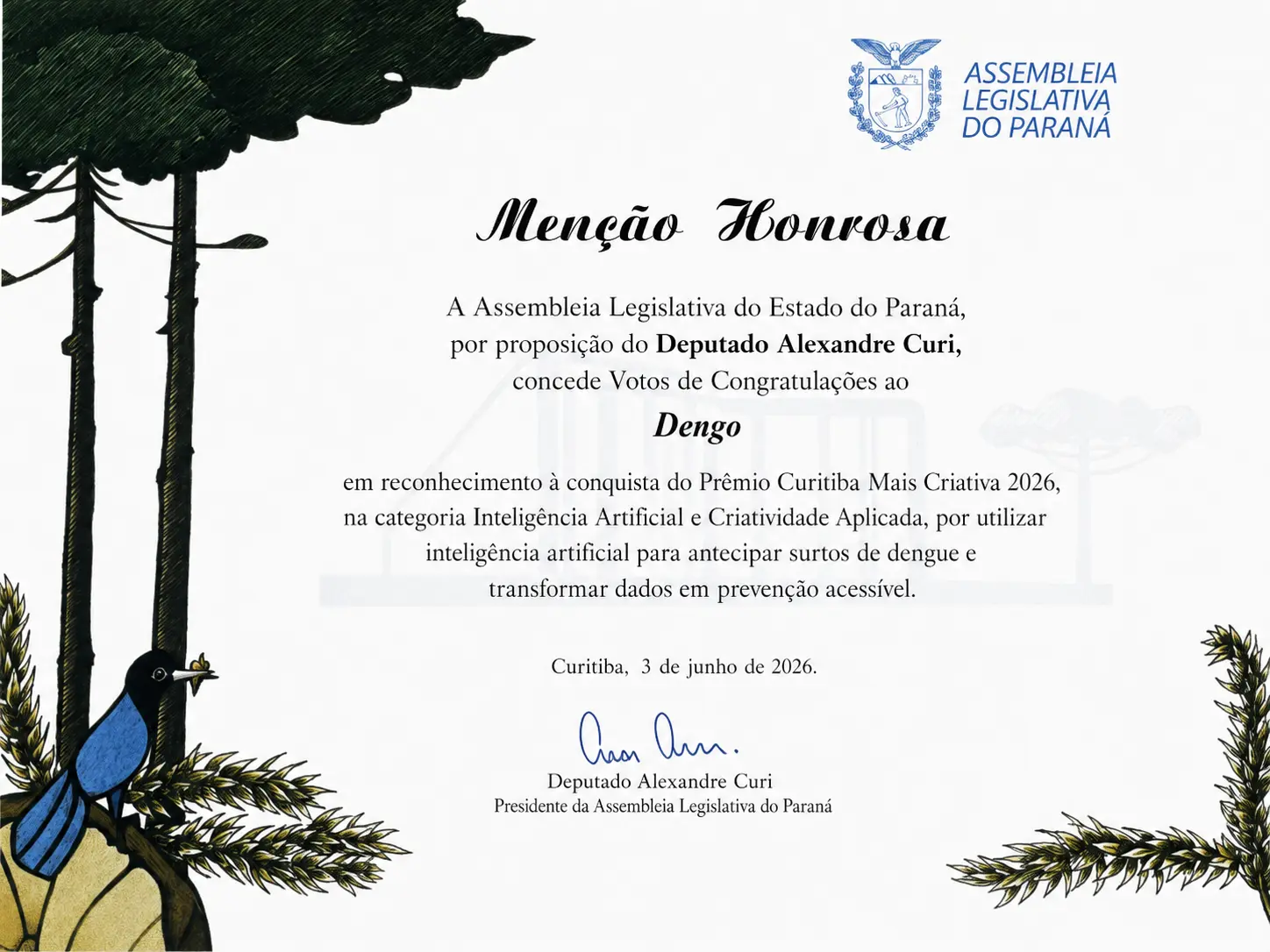
Legislative Assembly of Paraná · Official commendation
Computer program registered with Brazil's INPI · Process BR512026004146-5.

Data Engineer · AI, Machine Learning, Big Data and automation
Founder and developer of Dengo AI, with professional experience at Volvo Group, Votorantim and Vivo. Software Engineering student at UNINTER, DIO Expert ambassador and early-career technology mentor.
Dengo AI is a venture in formation, currently without a dedicated legal entity. Its software is registered with Brazil's INPI under process BR512026004146-5.
Review the results, current limitations and technical gates that guide Dengo AI's development.